Building capability to act and adapt
Plans, procedures and strategies provide important direction, but they are only part of the picture.
Organisations also need the capability to understand the systems they operate within, work across organisational boundaries, translate direction into action, learn through implementation and adapt as conditions change.
My approach brings together systems thinking, collaborative learning, simulation and adaptive implementation to help organisations build organisational resilience and adaptive capacity over time.
That philosophy underpins every engagement.
The ideas that shape my work
Three ideas underpin the way I approach preparedness, regardless of the organisation or challenge.
Recovery reveals resilience. Preparedness creates it.
Disruption reveals the relationships, capabilities, assumptions and ways of working that already exist.
Preparedness is the opportunity to strengthen them before they are tested.
Communities experience the whole system. Organisations see only part of it.
Communities experience the combined effects of many interconnected organisations and services.
Preparedness improves when those organisations build a shared understanding across the wider system.
Adaptive capacity grows through learning
Organisations strengthen their ability to adapt by building understanding, testing assumptions and learning from experience.
Learning before and through action creates opportunities to adjust, strengthen capability and respond as conditions change.
From understanding to adaptive action
Preparedness rarely develops through a single workshop, exercise, or plan.
It develops progressively as organisations strengthen understanding, improve decision-making, build relationships, and learn together over time.
The preparedness learning journey provides a simple way of thinking about how preparedness develops.
Rather than treating preparedness as a destination, it recognises it as an ongoing process of learning, adaptation and capability development.
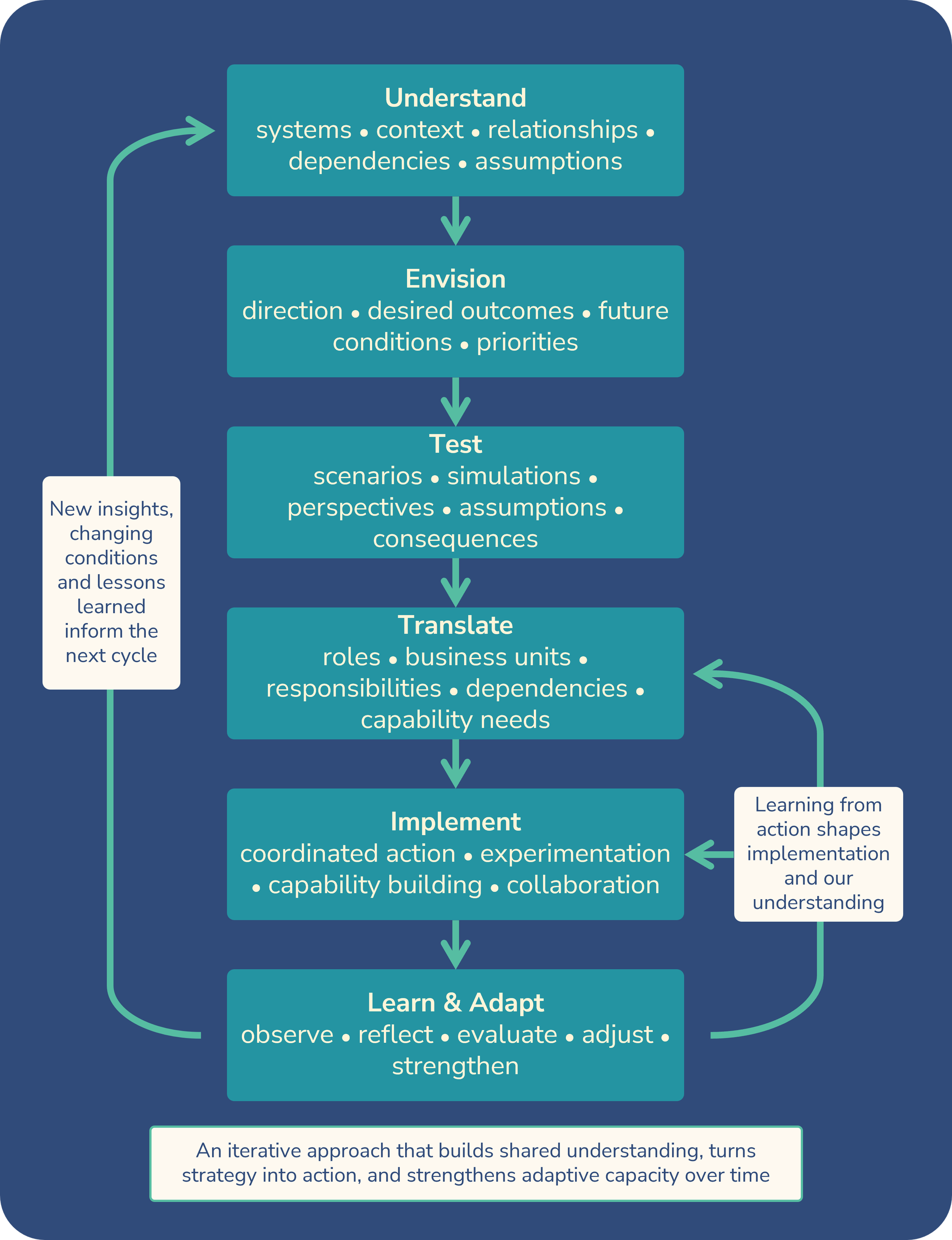
Understanding before solutions
My work rarely begins with recommendations.
It begins with understanding.
Together, we explore questions such as:
What system are we operating within?
Who else is part of that system?
What relationships influence success?
Where are the dependencies?
What assumptions are shaping decisions?
Who holds different parts of the picture?
Systems thinking helps make visible connections that can otherwise be difficult to see - across teams, services, organisations and communities.
For implementation, this means exploring where a strategy touches different parts of the organisation, how those areas depend on one another, where barriers or capability gaps may exist, and what needs to connect for action to occur.
The aim is to use systems thinking practically - building the shared understanding needed for better decisions, coordinated action and adaptation as conditions change.
Testing, learning and adapting
Organisations learn by testing ideas, experiencing different perspectives and reflecting on what happens in practice.
Scenarios and simulations create opportunities to explore uncertainty, reveal assumptions and dependencies, and consider potential consequences before action is taken.
As implementation progresses, reflection and learning help organisations understand what is working, what is changing and where adaptation may be needed.
This can help organisations:
test assumptions
explore consequences
reveal dependencies
strengthen relationships
improve decision-making
learn through implementation
adapt as conditions change
Together, these experiences help organisations learn before and through action, strengthening their capacity to respond and adapt as conditions change.
From strategy to implementation
Plans and strategies provide direction, but direction alone does not create change.
Implementation often crosses organisational boundaries. Different teams may hold different responsibilities, perspectives and capabilities, while depending on one another in ways that are not always visible when a strategy is developed.
Turning strategic direction into action requires people to understand what it means for their work, how their role connects with others, and where coordination, capability and shared learning are needed.
Through facilitated implementation processes, organisations can:
build shared ownership
translate strategy across teams and business areas
clarify roles and dependencies
identify capability and coordination needs
turn strategic direction into practical action
learn and adapt as implementation progresses
Implementation is not simply about delivering a set of actions. It is an ongoing process of coordination, learning and adaptation as organisations discover what works, what changes and what needs further attention.
Building capability that stays
The aim is not simply to facilitate a workshop, deliver recommendations or provide expertise from outside the organisation.
Where appropriate, engagements are designed to strengthen the knowledge, tools, relationships and ways of working that people can continue to use themselves.
This might involve developing internal capability, creating practical tools and resources, supporting communities of practice, or helping teams establish ways to reflect, learn and adapt together.
Over time, the role of external support can reduce as capability becomes embedded within the organisation.
Every organisation has a different starting point
No two organisations - or challenges - have exactly the same starting point.
The approach is therefore not a fixed sequence. An engagement might begin with understanding a system, testing a challenge through simulation, translating an existing strategy into action, or strengthening capability around an implementation challenge.
While every engagement is different, the underlying approach remains consistent:
Build understanding
Strengthen relationships
Improve decision-making
Support adaptation
Strengthen preparedness
Uncertainty cannot be eliminated.
But organisations can become better equipped to navigate it — by understanding the systems they operate within, working across organisational boundaries, turning plans into action, and learning and adapting as conditions change.
If this approach resonates with your organisation or partnership, I'd be happy to start a conversation.